
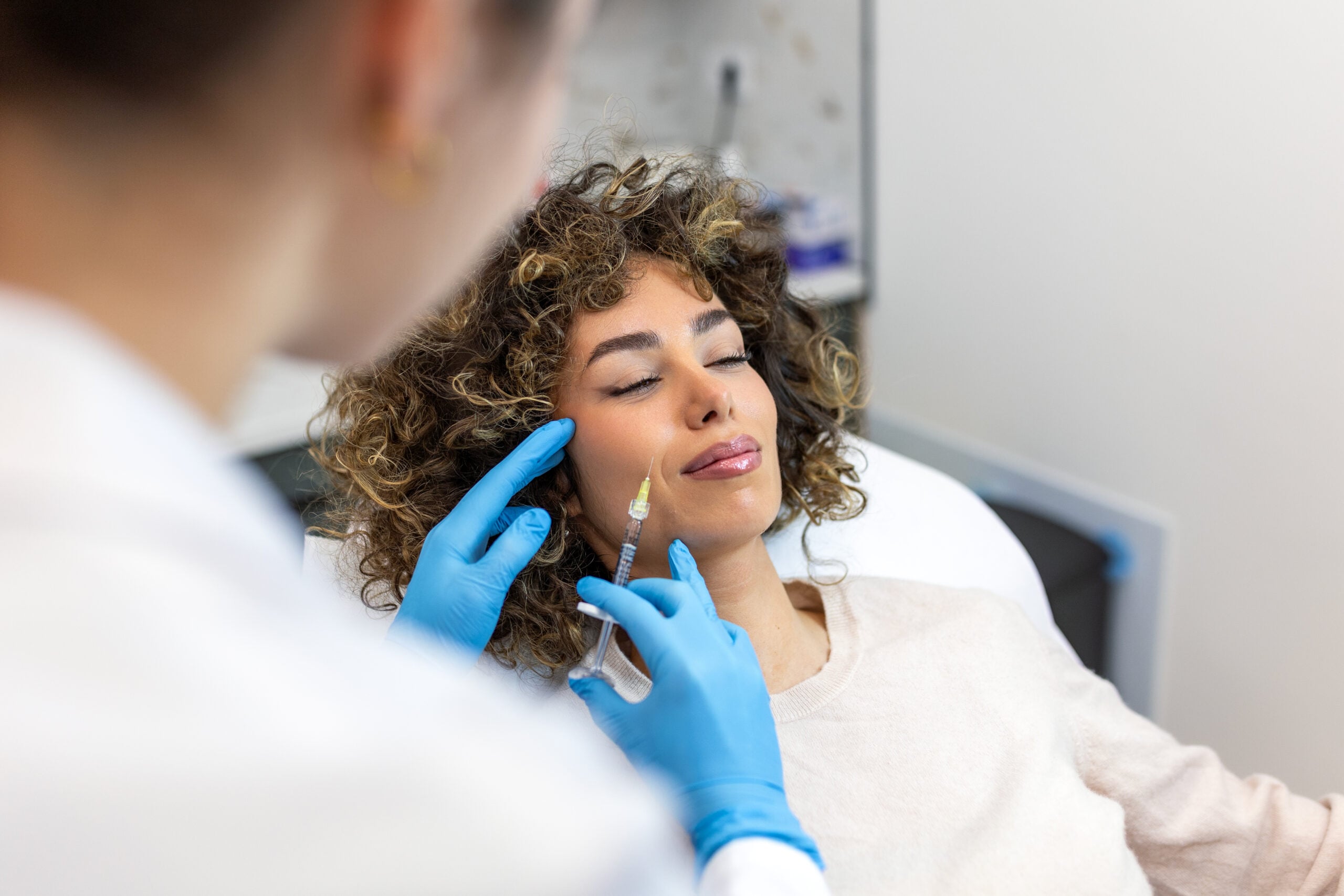
Natural-Looking Botox and Preventative Aesthetic Care
- Natural-looking Botox softens expression lines without making your face look completely frozen or noticeably different.
- Baby Botox uses a more conservative treatment approach for people who want subtle results and more facial movement.
- Preventative Botox may help slow the development of deeper expression lines, but there is no ideal age when everyone needs to start.
Why Does Natural-Looking Botox Look Different?
Natural-looking Botox works by softening targeted muscle movement while preserving enough expression for your face to still feel like your own. The dose and placement should reflect how your individual muscles move rather than follow the same formula for everyone.
Botox temporarily reduces the activity of specific muscles responsible for expression lines. Carefully treating targeted muscles can soften wrinkles while allowing patients to maintain natural facial expressions.
That balance is where injector experience really matters.
Two people can walk into a consultation worried about the exact same forehead line and need very different treatment plans. One person may have strong forehead movement. Another may naturally rely on those muscles to hold their brows in position. Treating them identically would not necessarily produce identical results.
A thoughtful injector looks at your face while it’s moving, not just while you are sitting still. We want to see how you raise your brows, squint, smile, and frown before deciding where treatment belongs.
Natural results come from responding to your anatomy and your movement, not chasing a predetermined number of units.
What Is Baby Botox?
Baby Botox is an informal term for using smaller, carefully placed amounts of Botox to create a subtle result. It is not a different type of Botox or a separate product.
People often ask for Baby Botox because they want to ease into treatment. They may be noticing their first expression lines, trying Botox for the first time, or simply prefer to keep more movement.
However, using less Botox is not automatically better.
If your muscles are particularly strong, an overly small dose may wear off quickly or may not create the result you were hoping for. Someone else may need very little treatment to soften the same area.
So, while Baby Botox can be a useful way to describe a conservative approach, we wouldn’t treat the phrase as a dosing formula. The better question is how much treatment will give you the level of movement and softening you want.
What Is Preventative Botox?
Preventative Botox targets repeated muscle movement before expression lines become deeply visible when your face is resting. The idea is to decrease some of the repetitive folding that contributes to wrinkles over time.
You can see the difference by looking at your face in motion and then at rest.
A dynamic line appears when you raise your eyebrows, squint, or frown. A static line remains visible after the expression stops.
Botox is particularly effective at treating dynamic wrinkles because it temporarily relaxes the muscles creating that repeated movement. Its effects generally last around three to four months, although duration varies.
Preventative treatment takes that same mechanism and uses it earlier, before a line has become deeply etched into the skin. That doesn’t mean everyone should start Botox the moment they notice a tiny crease.
Preventative aesthetics should still be about addressing something that matters to you, not treating a birthday.
Does Preventative Botox Actually Prevent Wrinkles?
Preventative Botox may help slow the development of some expression lines, but we don’t have enough long-term evidence to promise that starting Botox early will prevent wrinkles altogether. Aging involves much more than muscle movement.
There is a reasonable idea behind preventative treatment. If the skin folds less aggressively and less often, those folds may take longer to become deeply established.
A 2025 review of preventative botulinum toxin found evidence suggesting that early treatment may reduce muscle overactivity and delay the development of static lines. However, the existing research varies considerably, and stronger long-term studies are still needed.
There is also an interesting long-term study involving identical twins. One twin had regular Botox treatments for years while the other had far fewer treatments. The regularly treated twin developed fewer visible lines in the treated areas. It is fascinating research, but it involved only one pair of twins, so it shouldn’t be treated as proof that everyone will have the same outcome.
Botox also can’t prevent every part of facial aging.
Sun exposure, collagen loss, genetics, skin quality, changes in facial volume, and lifestyle all affect how the face changes over time. Daily sunscreen may ultimately do more for preventing premature skin aging than starting Botox simply because you reached a particular age.
When Should You Start Preventative Botox?
There is no single best age to start preventative Botox. It may be worth considering when expression lines start lingering after your face relaxes or when repeated movement in a particular area begins bothering you.
We would much rather look at your face than your birth year.
Some people naturally have very strong frown muscles in their twenties. Someone else may reach their late thirties with barely noticeable expression lines. Genetics, facial anatomy, sun exposure, skin quality, and the way you use your facial muscles all affect when lines develop.
A good consultation looks at things like how strongly your muscles contract, whether your lines remain visible at rest, which expressions you want to preserve, and what bothers you.
And if nothing bothers you yet, there is no requirement to start.
Preventative aesthetics should feel intentional, not like another item on a checklist you suddenly need to complete because you turned 30.
Can Botox Look Natural and Still Work?
Yes. Botox doesn’t need to remove every bit of movement to soften wrinkles effectively. Careful dosing can reduce excessive muscle activity while preserving the expressions that make your face look natural.
This is probably the misconception we hear most often.
People sometimes think they have to choose between wrinkles and a frozen forehead. There is a lot of room between those two extremes.
Clinicians can inject enough botulinum toxin to relax the targeted muscles without unnecessarily affecting surrounding muscles, allowing natural expressions to remain.
In practice, natural-looking Botox often comes down to a few small decisions. How much movement should we keep? Which muscle is actually creating the line? How does treating one area affect another?
Sometimes the right decision is even to leave an area alone. The goal is usually softer movement, smoother lines, and a result that doesn’t announce itself.
What Should First-Time Botox Patients Know?
Your first Botox appointment should start with a conversation about your face, your movement, and how subtle you want the result to be. You don’t need to arrive knowing exactly how many units you want.
In fact, we would rather you tell us what you notice.
Maybe your makeup settles into a forehead line by the end of the day or you constantly look tired or concerned in photos even when you feel great. Or maybe you have seen Botox results you dislike and want to make sure yours look different.
Those details are more useful than walking in with a unit count you saw online.
Botox results also develop gradually rather than the moment you leave the appointment. Most people begin noticing a change within several days, and the effects typically last around three to four months.
How you respond to that first treatment also gives your injector useful information for the next one. If you loved having more movement in one area or wanted another area slightly softer, the treatment plan can evolve with you.
That is how personalized Botox should work.
Natural Results Start With an Individual Treatment Plan
The rise of preventative aesthetics is not really about starting Botox younger. At its best, it reflects a broader change in what people want from aesthetic treatments.
Less obvious treatment. More personalization. Results that support the face you already have rather than trying to create a different one.
At Kintsu MedSpa & Wellness, we approach Botox with that same philosophy. We evaluate your facial anatomy and movement, talk through how much expression you want to keep, and build the treatment around your goals rather than a preset formula. We currently offer Botox and other wrinkle relaxers at our Berkeley and Davis locations.
Ready to find the right approach for your face and goals? Book an appointment at Kintsu MedSpa & Wellness in Berkeley or Davis.